Glass fibre GF

PET-GF

Material characteristics

Automotive parts, jigs and fixtures, mechanical components.

Contact Addimaker →

Key data

Values are typical figures published by AddiMaker, measured in the X-Y (in-plane) direction. FDM parts are usually markedly weaker between layers (Z), so allow margin along the real load path; moisture-sensitive grades (PA / PET / PC) must be dried before printing.

Density
1.38 g/cm³
Water absorption
0.50 %
HDT (0.45 MPa)
77 ℃
Tensile strength (X-Y)
65 MPa
Elongation at break (X-Y)
2.53 %
Flexural strength (X-Y)
99 MPa

Where it sits in the range

  • HDT (0.45 MPa) 77℃: 3 of 3 in its family, 17 of 24 across the range.
  • Tensile strength (X-Y) 65MPa: 2 of 3 in its family, 13 of 24 across the range.
  • Density 1.38 g/cm³ — the highest across the range.

Where it is used

The parts this material is most often asked to print in real projects.

  • Automotive parts and interior brackets
  • Jigs, fixtures and gauges
  • Mechanical components and drive supports

Who buys it

Industries and teams that typically order this material — use it to check the fit for your project.

  • Automotive parts plants
  • Tooling and fixture shops
  • Machinery manufacturers

Sources: Chatelet – glass-filled nylon parts

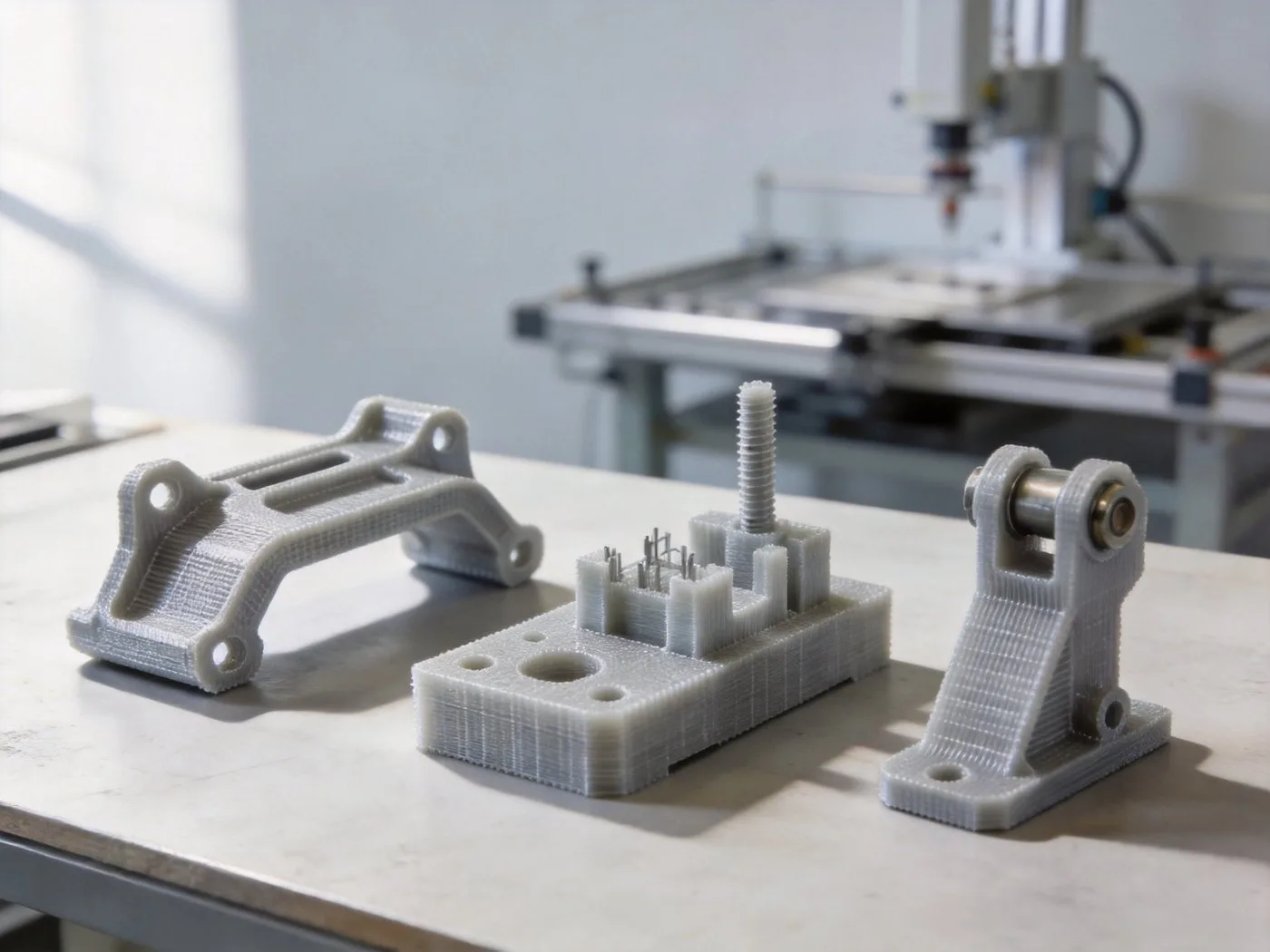
PET-GF Where it is used: Automotive parts and interior brackets
Illustration of the part types and use cases typical for this material — not a photograph of shipped parts.

When to choose it — and when not to

Read the "Not suitable for" column first. If your project lands there, changing material is far cheaper than tuning parameters.

Suitable for

  • Automotive parts and interior brackets
  • Jigs, fixtures and gauges
  • Mechanical components and drive supports
  • Medium-rigidity parts where low warping matters

Not suitable for

  • Sustained service above 70–75 °C — the lowest HDT in this range
  • High impact
  • Permanent high humidity
  • Class-A cosmetic faces

Where to go when this grade is not enoughMore heat → PAHT-GF. More stiffness → PET-CF.

Printing and post-processing

Parameters are set against the VULCAN platform limits — nozzle up to 525 °C, bed up to 150 °C, chamber up to 150 °C held constant — so every value below runs on our machines as written. Still print a temperature tower and flow calibration on your first part, then lock the batch recipe.

Drying
80 °C / 6 h
Nozzle
250–280 °C, hardened nozzle
Bed
70–80 °C
Chamber
40 °C optional
Speed
30–50 mm/s
Support
Peels easily
Warping
Low

Post-processingCan do: sanding, tapping, inserts. Cannot do: vapour smoothing.

Other materials in this family

Characteristics and key data for the rest of the family; select a name to open its page.

High-temperature nylon base: high strength, high wear resistance, excellent chemical resistance and high heat resistance. Good dimensional stability in printing with no warping or shrinkage; for heat-resistant insulating structural parts and wear-resistant components.

Density
1.27 g/cm³
Water absorption
1.75 %
HDT
83 ℃
Tensile strength
84 MPa
Elongation at break
2.71 %
Flexural strength
138 MPa

Heat-resistant insulating structural parts; impact-resistant components.

Density
1.30 g/cm³
Water absorption
0.22 %
HDT
109 ℃
Tensile strength
63 MPa
Elongation at break
6.70 %
Flexural strength
108 MPa

Characteristics and key data are sourced from 艾迪造物 AddiMaker《增材制造材料解决方案》2026-09-04.

From this material to a part

The material is only the starting point. Three things decide whether it becomes a part you can actually assemble.

Custom & delivery

Size limits, tolerance, finishing, batch size and lead time — and what we do when a part falls outside them.

See capability limits →

Technical communication

DFM feedback within 24–48 hours of receiving a STEP file, material selection by duty, first-article validation.

See the process →

Confidentiality & IP

NDA available, drawings used for your project only, all public cases anonymised.

Read our commitment →

Need PET-GF samples or a quote?

Send your printer, volume, service temperature and lead time to the address below; we reply with alternative material options as well. [email protected]

← Back to the material range