Values are typical figures published by AddiMaker, measured in the X-Y (in-plane) direction. FDM parts are usually markedly weaker between layers (Z), so allow margin along the real load path; moisture-sensitive grades (PA / PET / PC) must be dried before printing.
Density
1.27 g/cm³
Water absorption
0.06 %
HDT (0.45 MPa)
139 ℃
Tensile strength (X-Y)
92 MPa
Elongation at break (X-Y)
5.00 %
Flexural strength (X-Y)
145 MPa
Where it sits in the range
HDT (0.45 MPa) 139℃: 2 of 2 in its family, 6 of 24 across the range.
Tensile strength (X-Y) 92MPa: 2 of 2 in its family, 6 of 24 across the range.
Density 1.27 g/cm³ — in the middle of the range.
Where it is used
The parts this material is most often asked to print in real projects.
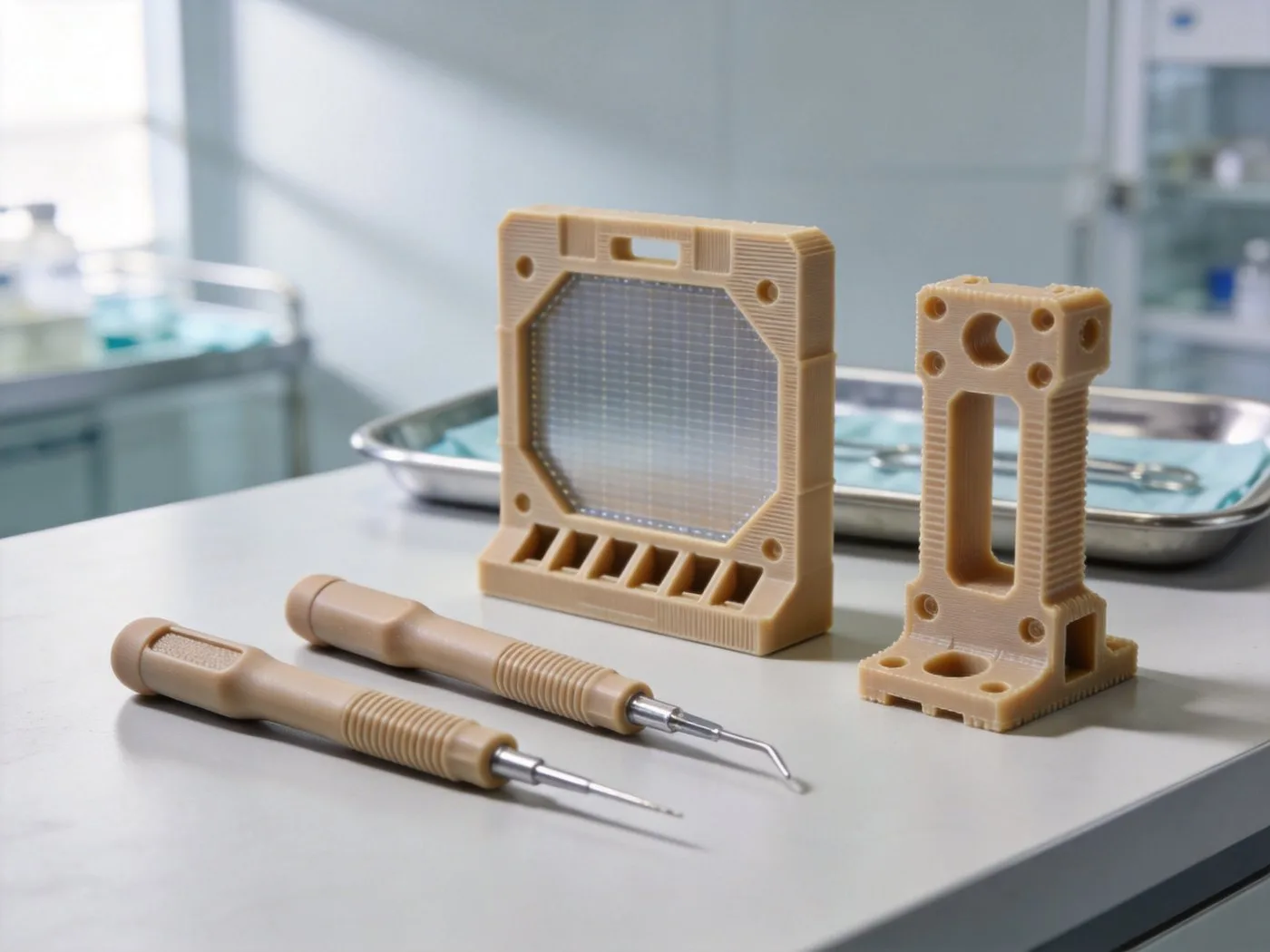
Repeatedly sterilisable surgical instrument handles and guides
Aerospace brackets, heat shields and engine-adjacent parts
Semiconductor wafer handling parts and fixtures
Corrosion-resistant chemical parts
Who buys it
Industries and teams that typically order this material — use it to check the fit for your project.
Illustration of the part types and use cases typical for this material — not a photograph of shipped parts.
When to choose it — and when not to
Read the "Not suitable for" column first. If your project lands there, changing material is far cheaper than tuning parameters.
Suitable for
Surgical instruments and trays that are repeatedly sterilised
Aerospace brackets, thermal barriers and harness clamps
Semiconductor wafer handling fixtures
Corrosion-resistant chemical pump and valve parts
Not suitable for
Cost-sensitive general industrial parts — both material and process are expensive
High impact — unmodified PEEK has limited toughness
Machines without a 90 °C+ chamber — you will not reach the properties
Parts that must be transparent
Where to go when this grade is not enoughThis is the top of the range: for more stiffness go to PEEK-CF; for static dissipation or thermal conduction PEEK-CF works (fibre gives dissipation and conduction, not metallic conduction); when budget is the constraint, step down to PPS-CF or PAHT-CF.
Printing and post-processing
Parameters are set against the VULCAN platform limits — nozzle up to 525 °C, bed up to 150 °C, chamber up to 150 °C held constant — so every value below runs on our machines as written. Still print a temperature tower and flow calibration on your first part, then lock the batch recipe.
Drying
150 °C / 4 h — mandatory
Nozzle
380–420 °C, all-metal high-temperature hotend
Bed
130–150 °C
Chamber
90–120 °C — mandatory
Speed
20–40 mm/s
Support
High-temperature soluble support; hard to remove
Annealing
200 °C / 2–4 h — mandatory to build crystallinity
Post-processingCan do: annealing, machining, sanding, polishing, autoclave sterilisation. Cannot do: vapour smoothing; standard equipment cannot post-process these parts.
Other materials in this family
Characteristics and key data for the rest of the family; select a name to open its page.
Send your printer, volume, service temperature and lead time to the address below; we reply with alternative material options as well. [email protected]