Elastomers

PEBA95A

Material characteristics

Extreme rebound, exceptional fatigue resistance and low weight; shoe midsoles, soft robotics, medical flexible tubing.

Contact Addimaker →

Key data

Values are typical figures published by AddiMaker, measured in the X-Y (in-plane) direction. FDM parts are usually markedly weaker between layers (Z), so allow margin along the real load path; moisture-sensitive grades (PA / PET / PC) must be dried before printing.

Density
1.01 g/cm³
Water absorption
1.68 %
HDT (0.45 MPa)
70 ℃
Tensile strength (X-Y)
28 MPa
Elongation at break (X-Y)
≥1000 %
Flexural strength (X-Y)
30 MPa

Where it sits in the range

  • HDT (0.45 MPa) 70℃: 1 of 2 in its family, 18 of 24 across the range.
  • Tensile strength (X-Y) 28MPa: 2 of 2 in its family, 24 of 24 across the range.
  • Density 1.01 g/cm³ — the lowest across the range.

Where it is used

The parts this material is most often asked to print in real projects.

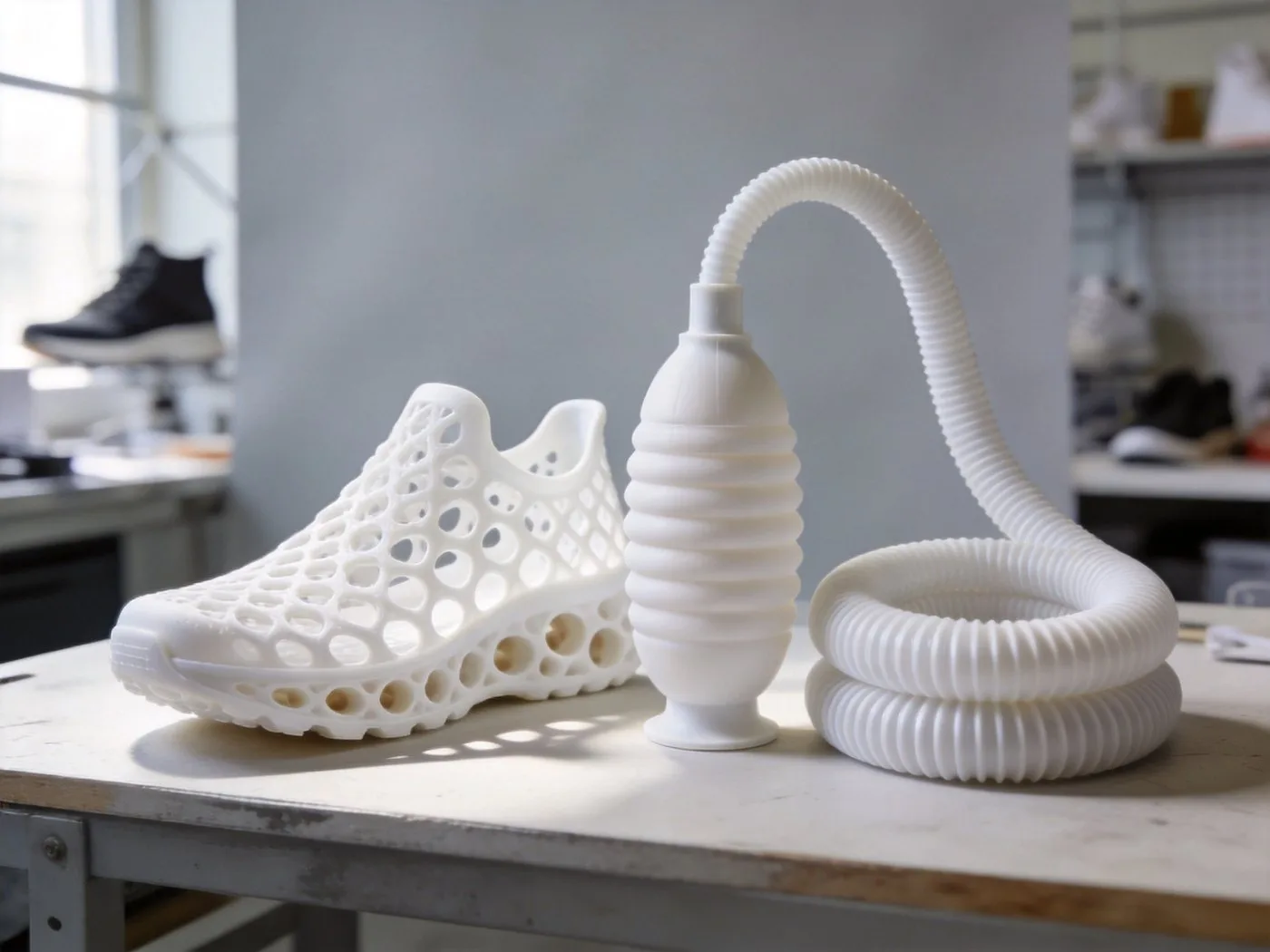
  • Lattice midsoles
  • Soft robotics pneumatic parts and bellows
  • Medical flexible tubing
  • High-fatigue-resistance elastic parts

Who buys it

Industries and teams that typically order this material — use it to check the fit for your project.

  • Sports footwear brands and sole makers
  • Soft robotics R&D teams
  • Medical device makers

Sources: TPM3D – SLS PEBA footwear李宁 PEBA 3D 打印鞋案例

PEBA95A Where it is used: Lattice midsoles
Illustration of the part types and use cases typical for this material — not a photograph of shipped parts.

When to choose it — and when not to

Read the "Not suitable for" column first. If your project lands there, changing material is far cheaper than tuning parameters.

Suitable for

  • Shoe midsoles, soft robotics, medical flexible tubing
  • Soft robotics pneumatic parts and bellows
  • Flexible tubing and sealing convolutions
  • High-rebound parts that flex millions of times

Not suitable for

  • High-temperature service
  • Load-bearing structure
  • Precision mating faces — elastic deformation ruins the fit
  • Parts that need a rigid cosmetic look

Where to go when this grade is not enoughHarder → TPU95A. Structural load → PAHT.

Printing and post-processing

Parameters are set against the VULCAN platform limits — nozzle up to 525 °C, bed up to 150 °C, chamber up to 150 °C held constant — so every value below runs on our machines as written. Still print a temperature tower and flow calibration on your first part, then lock the batch recipe.

Drying
60 °C / 4 h
Nozzle
230–250 °C
Bed
50–60 °C
Chamber
Not required
Speed
20–40 mm/s
Retraction
Minimal
Support
Hard to remove — design it out
Hardware
Direct drive preferred

Post-processingCan do: bonding, cutting, heat forming. Cannot do: tapping, polishing, vapour treatment.

Other materials in this family

Characteristics and key data for the rest of the family; select a name to open its page.

Industrial parts and assemblies (protective covers, guides, hinges, soft grippers); sports equipment (insoles, sporting goods); medical and rehabilitation devices.

Density
1.20 g/cm³
Water absorption
0.18 %
HDT
53 ℃
Tensile strength
35 MPa
Elongation at break
≥800 %
Flexural strength
4.47 MPa

Characteristics and key data are sourced from 艾迪造物 AddiMaker《增材制造材料解决方案》2026-09-04.

From this material to a part

The material is only the starting point. Three things decide whether it becomes a part you can actually assemble.

Custom & delivery

Size limits, tolerance, finishing, batch size and lead time — and what we do when a part falls outside them.

See capability limits →

Technical communication

DFM feedback within 24–48 hours of receiving a STEP file, material selection by duty, first-article validation.

See the process →

Confidentiality & IP

NDA available, drawings used for your project only, all public cases anonymised.

Read our commitment →

Need PEBA95A samples or a quote?

Send your printer, volume, service temperature and lead time to the address below; we reply with alternative material options as well. [email protected]

← Back to the material range