Structural and cosmetic parts requiring high rigidity.
- Density
- 1.09 g/cm³
- Water absorption
- 0.30 %
- HDT
- 90 ℃
- Tensile strength
- 48 MPa
- Elongation at break
- 1.48 %
- Flexural strength
- 49 MPa
Carbon fibre CF
Material characteristics
Impact-resistant components.
Values are typical figures published by AddiMaker, measured in the X-Y (in-plane) direction. FDM parts are usually markedly weaker between layers (Z), so allow margin along the real load path; moisture-sensitive grades (PA / PET / PC) must be dried before printing.
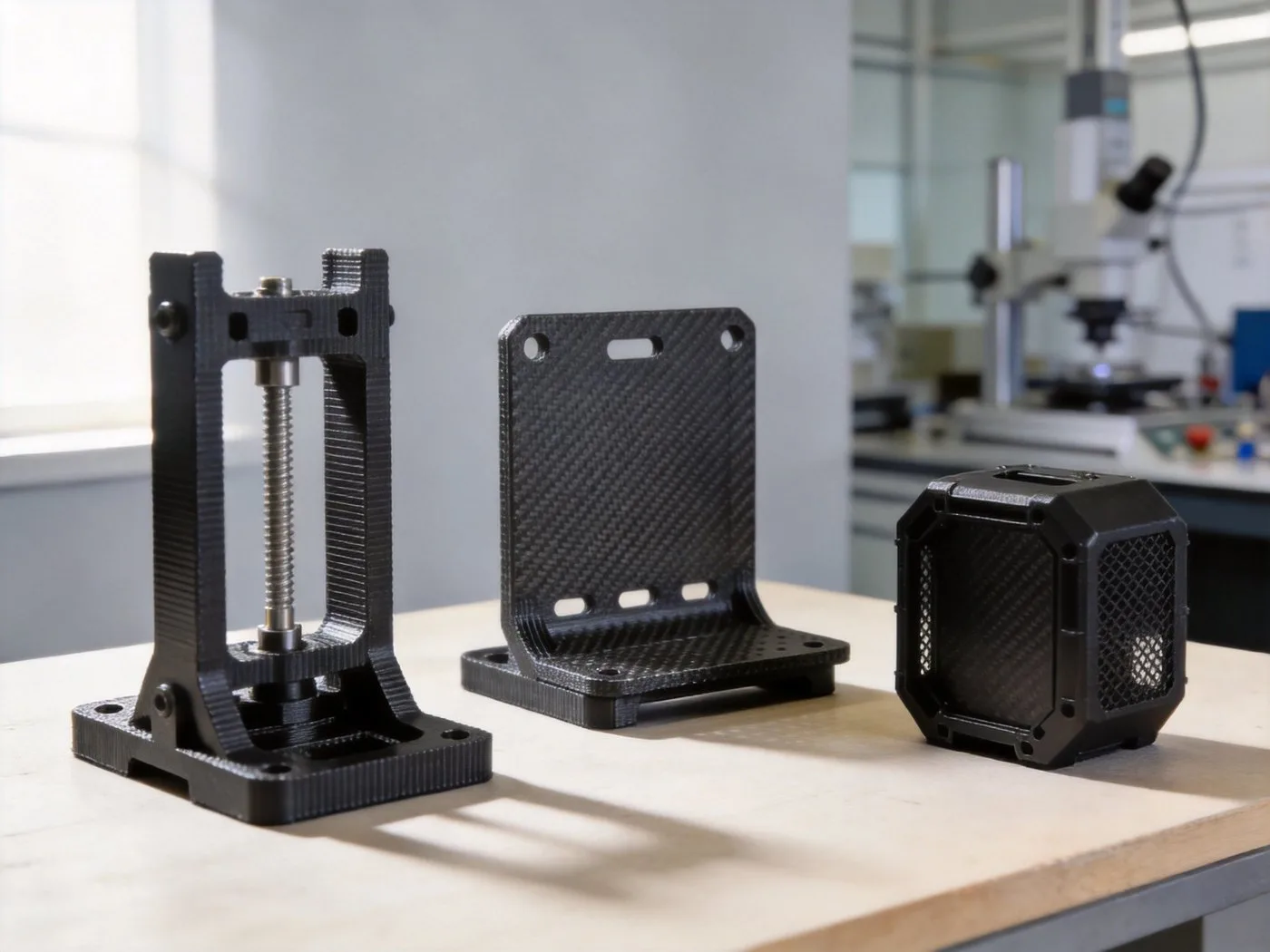
The parts this material is most often asked to print in real projects.
Industries and teams that typically order this material — use it to check the fit for your project.
Sources: Maker Factory – PC / PC-CF comparison3DALT – carbon fibre composites guide
Read the "Not suitable for" column first. If your project lands there, changing material is far cheaper than tuning parameters.
Where to go when this grade is not enoughMore heat → PPS-CF. Electrical insulation → PC-GF.
Parameters are set against the VULCAN platform limits — nozzle up to 525 °C, bed up to 150 °C, chamber up to 150 °C held constant — so every value below runs on our machines as written. Still print a temperature tower and flow calibration on your first part, then lock the batch recipe.
Post-processingCan do: sanding, tapping, inserts, secondary machining. Cannot do: vapour smoothing; never use for insulating parts.
Electrical: Electrical behaviour of a carbon-fibre part has to be measured, never assumed from the grade name. Unfilled PC, PA and PPS print with surface resistance above 10¹³ Ω; adding carbon fibre brings it down to 10⁵–10¹² Ω, depending on fibre loading, fibre length and print orientation. On the same batch, in-layer versus through-layer, before and after sanding, and different part orientations routinely differ by one to two orders of magnitude. Measure per ASTM D257 or IEC 62631-3-1 on the real part with the real print parameters — not on a test bar. 10⁴–10¹¹ Ω is usable for static dissipation; anything needing dielectric withstand should move to a glass-fibre or unfilled grade.
Characteristics and key data for the rest of the family; select a name to open its page.
Structural and cosmetic parts requiring high rigidity.
High-temperature, high-strength structural and cosmetic parts; wear-resistant components.
Load-bearing structural parts; automotive parts, jigs and fixtures, mechanical components.
Load-bearing structural parts; automotive parts, jigs and fixtures, mechanical components.
Characteristics and key data are sourced from 艾迪造物 AddiMaker《增材制造材料解决方案》2026-09-04.
The material is only the starting point. Three things decide whether it becomes a part you can actually assemble.
Size limits, tolerance, finishing, batch size and lead time — and what we do when a part falls outside them.
DFM feedback within 24–48 hours of receiving a STEP file, material selection by duty, first-article validation.
NDA available, drawings used for your project only, all public cases anonymised.
Send your printer, volume, service temperature and lead time to the address below; we reply with alternative material options as well. [email protected]