Entry-level modified grade with dependable mechanical properties.
- Density
- 1.30 g/cm³
- Water absorption
- 0.51 %
- HDT
- 50 ℃
- Tensile strength
- 29 MPa
- Elongation at break
- 8.43 %
- Flexural strength
- 68 MPa
Engineering basics
Material characteristics
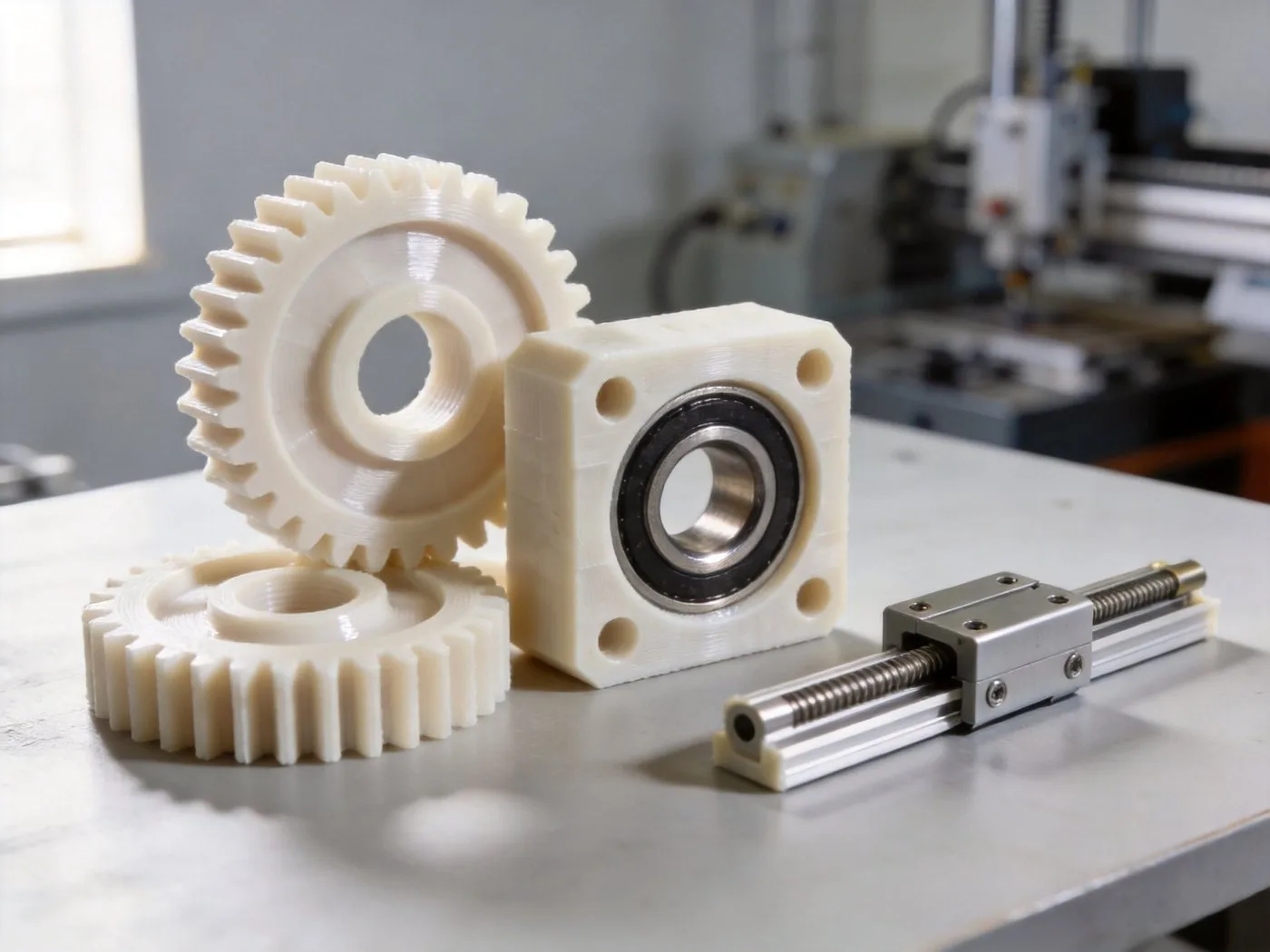
High surface finish and self-lubricating; for structural parts and gear components.
Values are typical figures published by AddiMaker, measured in the X-Y (in-plane) direction. FDM parts are usually markedly weaker between layers (Z), so allow margin along the real load path; moisture-sensitive grades (PA / PET / PC) must be dried before printing.
The parts this material is most often asked to print in real projects.
Industries and teams that typically order this material — use it to check the fit for your project.
Sources: Siraya Tech – PPA/PAHT filament dataFilabase – wear-resistant filament ranking
Read the "Not suitable for" column first. If your project lands there, changing material is far cheaper than tuning parameters.
Where to go when this grade is not enoughMore stiffness → PAHT-CF. More heat → PPS or PPA. Electrical insulation → PAHT-GF.
Parameters are set against the VULCAN platform limits — nozzle up to 525 °C, bed up to 150 °C, chamber up to 150 °C held constant — so every value below runs on our machines as written. Still print a temperature tower and flow calibration on your first part, then lock the batch recipe.
Post-processingCan do: sanding, tapping, heat-set inserts, annealing. Cannot do: vapour smoothing, prolonged water exposure.
Characteristics and key data for the rest of the family; select a name to open its page.
Entry-level modified grade with dependable mechanical properties.
High-flow modified ABS for fast printing, with a maximum practical extrusion rate of up to 28 mm³/s. Lower odour than standard ABS, better warp and crack resistance and excellent impact strength; for automotive, home appliance and similar parts.
High strength, good durability and good print flow; for product models, brackets and mechanical parts.
Characteristics and key data are sourced from 艾迪造物 AddiMaker《增材制造材料解决方案》2026-09-04.
The material is only the starting point. Three things decide whether it becomes a part you can actually assemble.
Size limits, tolerance, finishing, batch size and lead time — and what we do when a part falls outside them.
DFM feedback within 24–48 hours of receiving a STEP file, material selection by duty, first-article validation.
NDA available, drawings used for your project only, all public cases anonymised.
Send your printer, volume, service temperature and lead time to the address below; we reply with alternative material options as well. [email protected]